Twin tropical storms Marco and Laura will make landfall Monday and Tuesday bringing some storm surge warnings, evacuations and possible travel restrictions.
A storm surge warning remained in effect from Morgan City to Ocean Springs, Mississippi, where 2 to 4 feet of storm surge was possible. A tropical storm warning was still in effect from Morgan City, Louisiana, to the Alabama and Mississippi border, an area that includes New Orleans and Lake Pontchartrain. The mayor of Port Arthur, Texas has announced the city will be issuing a mandatory evacuation of the city, scheduled now for 6 a.m. Tuesday.
Marco is expected to near Louisiana by Monday afternoon, and will then turn northwest and remain along the coast for a time. Once Marco makes landfall, the storm is expected to produce an average of 3 to 5 inches of rain, and in some areas up to 10 inches, for portions of the Gulf Coast through Monday night. Isolated tornadoes were also possible.
Marco was forecast to finally weaken Monday night and dissipate by Tuesday.
As soon as Marco tapers off, Tropical Storm Laura is forecast to be bigger and stronger. When Laura enters the Gulf of Mexico on Tuesday, the forecast may really get interesting.
Right now landfall is projected to be late Wednesday or early Thursday as a strong 105 mph Category 2 storm, borderline Category 3, near the Texas and Louisiana border. Meteorologists are unsure how strong Laura will get.
From late Wednesday through Friday, Laura is expected to produce rainfall of 5 to 10 inches, locally up to 15 inches, near the Texas and Louisiana border north into portions of the lower Mississippi Valley.
Laura may rapidly intensify, in which case maximum sustained winds would have to increase by 35 mph in 24 hours.
This will be important to watch, as a stronger Laura would head more west toward Houston whereas a weaker storm would be steered more toward the Texas and Louisiana border.
Travel Restrictions
A couple of states have updates available, while other states are waiting to see how the storms progress.
Currently, there are no other official oversize travel restrictions in place by any state DOTs, but some could be announced soon, including permit changes and delays.
Florida: Any load over 14-6 tall, 10-0 wide, 80-0 long or 80,000 pounds cannot travel until further notice.
Alabama: If a driver can’t see 1,000 ft. in front, no travel is allowed.
Texas: Update 8/25: Due to storms in the Gulf of Mexico, some TXDOT Districts are prohibiting OS/OW movement on all or substantial portions of their roadways until further notice. Permit applications may be denied or delayed. The current affected areas are as follows: Beaumont District – all counties; Houston District -Galveston County.
Motor carriers transporting a divisible load that is overweight only to and within the areas affected by Tropical Storms Marco and Laura may self-issue a Federal Disaster Relief Permit through the Texas Permitting and Routing Optimization System (TxPROS). https://txpros.txdmv.gov/. The Federal Disaster Relief Permit allows for travel on all state and federal roads, including the interstate highway system. The permit may not be used for overwidth, overlength, or overheight loads. A copy of the President’s declaration must be carried with the permit. The declaration can be found here: https://www.whitehouse.gov/news/ or https://www.fema.gov/disasters/disaster-declarations.
Louisiana: Interstate 10 in southwest Louisiana is completely closed to traffic. I-10 eastbound is closed at the Texas/Louisiana state line, and I-10 westbound is closed west of the Atchafalaya Basin. Updated info is available on the Louisiana Department of Transportation & Development website.
Hurricane/Tropical Storm Tips for Truck Drivers
Truck drivers can keep some tips in mind for maintaining safety during these storms.
- Prepare for high winds. Before the storm even hits and the rain starts, the re’s most likely going to be lots of strong winds in the area. Don’t be afraid to pull your truck over if you encounter high winds.
- Pay attention to weather warnings, and stay in the know by hearing the forecast and communicating with your dispatcher.
- Be flexible. Be prepared for schedule, route delays and changes. The TX or LA DOT may issue travel restrictions for oversize loads or for all CMVs.
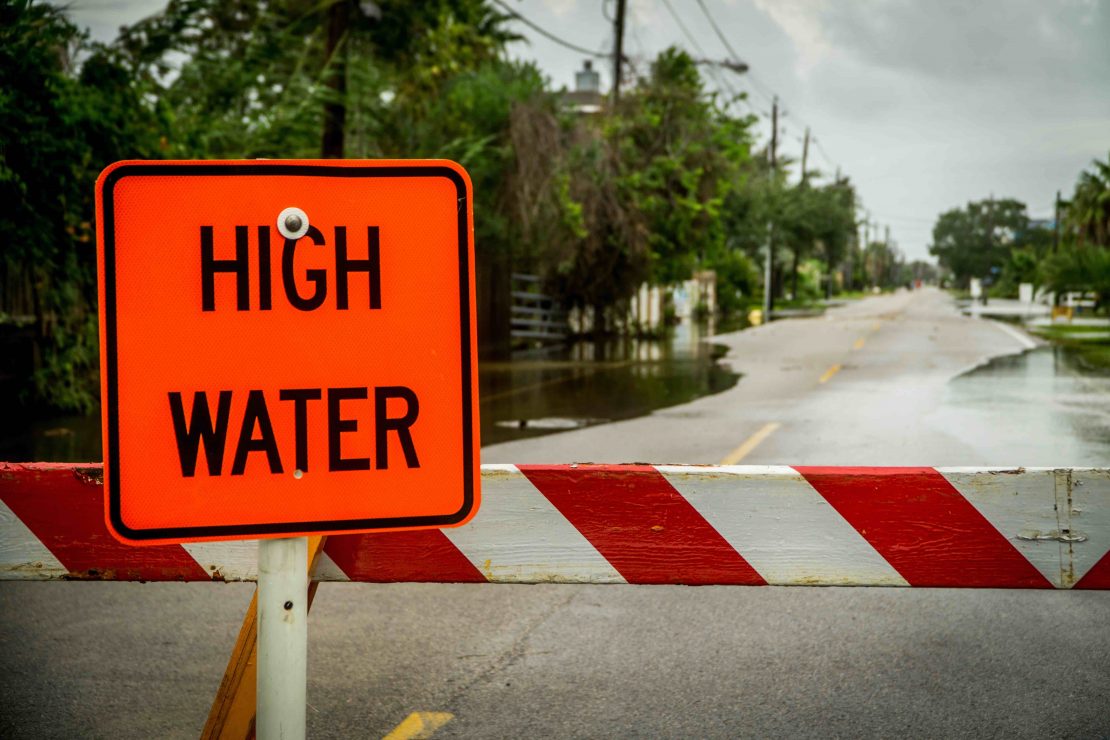
- Avoid flooded areas and driving through high water.
- Slow down on corners and ramps is always a good practice, especially in a storm.
Questions? Contact Medallion Transport & Logistics
Medallion’s Safety Team is ready to assist with driver education and training to ensure the company’s fleet is safe on the road and compliant with the latest laws. For questions about driver safety, give us a call at 704-235-0460, ext 2004 or send us an email to safety@medalliontrans.com.